


Mental Toughness isn’t something you can directly see. When people say someone “showed great mental toughness,” they’re actually referring to the visible outcomes: actions, decisions, and behaviours, not the trait itself.
Like the unseen portion of an iceberg, Mental Toughness lies beneath the surface. It is rooted in our values, beliefs, experiences, and instincts. While invisible, its effects are highly visible in how we act, speak, and respond to challenges.
Psychologists define Mental Toughness as an attitude shaped by our beliefs and life experiences. For instance, if someone grows up being told they are bad at something, they may internalise that belief. However, such attitudes are not fixed—they can change over time through new experiences and achievements.
Mental Toughness is the attitude that gives us the confidence to take on a challenge and the control to see our commitments through.
Mental Toughness is not related to physical strength and it has nothing to do with biceps, triceps, testosterone and the like and it applies in all walks of life; great musicians, great dancers, great scientists, great public speakers, great athletes and, in fact, anyone good at what they do, has high Mental Toughness.
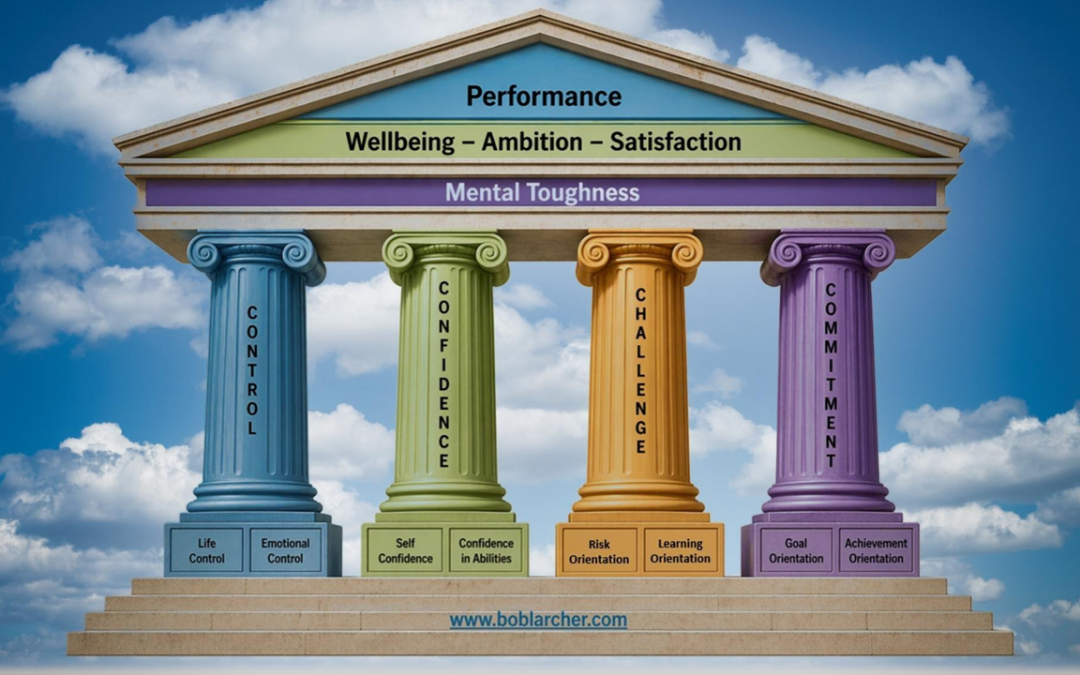
Mental Toughness is built on four pillars, each with two foundations.
The four pillars are often referred to as the 4C’s; Challenge, Commitment, Control and Confidence; however, it is the foundations that give each pillar its strength and stability.
The foundations of Challenge, sometimes called the “Have a go” attitude, are a willingness to step out of one’s comfort zone, or zones, and take on something challenging & the willingness to take time to learn from the experience, both from success and failure.
Commitment, or “Stickability”, is built on defining clear objectives with regards to the challenge undertaken & staying focussed and determined to achieve them.
Challenge and Commitment are “outward” focussed and it is here that lies one of the differences between Resilience and Mental Toughness.
Both Resilience and Mental Toughness are about being able to cope mentally and emotionally with a crisis; Resilience is more a reaction to a challenge when it arises, whereas Mental Toughness is more proactive and is about seeking out a challenge.
The “Can do” or Control pillar sits upon the control we have of our lives and our self-control in difficult (challenging) situations. Life Control is about the degree to which we make our major life decisions based on our own values, objectives, dreams, hope and desires whereas our self-control, or Emotional Control, is about our ability to channel the emotional energy created into something positive.
The Confidence pillar, our Self-belief pillar, has its roots in Interpersonal Confidence; our ability to remain assertive and be able to interact with a wide range of different people, be they more qualified, better paid, more experienced, etc.
The second foundation of the Confidence pillar is Confidence in our capacities, not just “knowing our stuff” but knowing that we know our stuff; knowing what we are good at and being confident in what we are dealing with.
To summarise
Mentally tough people are resilient whereas resilient people are not necessarily mentally tough.
Challenge is about being optimistic & curious; it is not about being reckless & closed.
Commitment is about being focussed & determined; it is not about being blinkered & stubborn.
Control is about being decisive & calm; it is not about being dogmatic & cold.
Confidence is about being assertive & grounded; it is not about being aggressive & arrogant.
Mental Toughness, until quite recently, has been quite an intangible concept and difficult to measure. Today, we know what it is and we have reliable methods for determining levels of Mental Toughness and yes, we all have a certain amount of Mental Toughness, some people may have more, and some people may have less but we all have a degree of Mental Toughness, we all have varying levels of “Can do”, “Stickability”, “Have a go” and “Self-belief”.
Studies have shown that Mental Toughness follows a normal distribution curve, some people have very low amounts, some people have very high amounts, and most people have an “average” amount of Mental Toughness. In fact, most of us have the level of Mental Toughness that we need to get through most of of our daily storms.
The starting point to developing Mental Toughness is in exploring the foundations and identifying potential “cracks”.
A good example of someone with (or who had) a crack in one of the foundations is Novak Djokovic. After several emotional outbursts during important matches, he admitted that he was letting his own, negative, emotions get in the way of his performance, and he began working on techniques & methods that allowed him to be aware of his emotions and manage them better during matches.
There are two ways of exploring the solidity of our foundations, the first is simply by asking oneself some questions and answering them honestly; Am I really in charge of my life? Do I challenge myself regularly? Do I stay calm in difficult situation, etc.
The second, and more reliable way, is to use a recognised & validated psychometric questionnaire such as the MTQPlus; a questionnaire that not only explores the foundations but also provides concrete developmental suggestion aligned to your results.
Once you know where your strengths and weaknesses lie, you can start building on your strengths and overcoming your weaknesses.
Mental Toughness can clearly be developed, but it doesn’t happen “overnight”; it is often an aggregation of small changes that must be maintained, consciously, until they become second nature.
Attitudinal change comes from experience, experiencing success where there was once only failure; this leads to a mind shift from “can’t do” to “can do”.
To quote Heny Ford, “Whether you think that you can, or that you can’t, you are usually right”
I help people to develop their interpersonal skills, usually within a leadership or teamwork context. If you are looking to develop your leadership, I might be able to help. I’ve been doing this for almost 40 years; roughly four thousand days of seminars, workshops, conferences, coaching, offsites, webinars, etc. – put back-to-back that makes almost ten “full” years.