


“Power tends to corrupt and absolute power corrupts absolutely.”
Lord Acton
I often hear & read about politicians and business leaders being labelled as “having power” and I often ask myself, how much power do they really “have” and how much is “given” to them?
We all “get stuff done” through the use of power, some of us use “personal power” (often called influence), some of us use “position power” (often called authority) and some of us use both (often called leading).
There are no “one” definitions of Personal power and Position Power; these are the definitions I have chosen for this article:
“Personal power is the ability to influence events and people through your own skills, knowledge, and personal attributes, rather than through formal authority or position.”
“Position power is derived from an individual’s formal role or position within an organisation. It is tied to the authority that comes with a title, rank, or job function.”
Both personal and position power have their “bright side” and “dark side”; one is not better or worse than the other – it is a question of how you use it!
The bright side of personal power is often portrayed as the self-effacing hero, encouraging those around them to stand up and fight, often against overwhelming odds, for what is “good & right” for everyone.
The dark side of personal power is often portrayed as a kind of charismatic guru, only interested in getting what is best for oneself.
The bright side of position power is often portrayed as the loyal administrator, applying strictly the rules and regulations to everyone, even to their own detriment.
The dark side of position power is often portrayed as the conniving and controlling “rule bender”; applying the rules & regulations to further their own ends and feather their own nest.
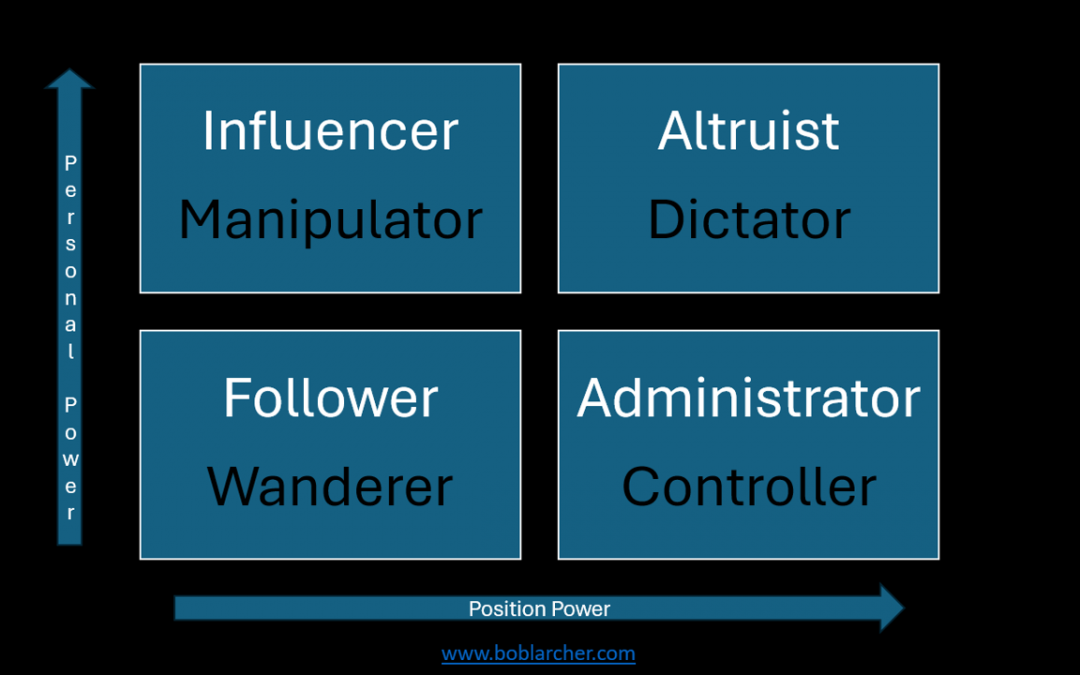
By looking at how much personal and position power people use (and how they use it), we can identify eight approaches (I hesitate to use the word “types”).
Followers & Wanderers are low on both personal and position power; however, Followers will actively and positively, participate in contributing to something, whereas Wanderers tend to flit aimlessly from activity to activity, rarely committing to anything.
Administrators & Controllers are high on position power and low on personal power; Administrators tend to “apply the rules” in all circumstances regardless of the position or social standing of others. Controllers on the other hand tend to be a little more selective to what is applied, to who & when, often benefiting themselves and their close circle.
Influencers & Manipulators both have high personal power; Influencers tend to use their power to have an impact on some kind of “greater good”. They will take time to listen to conflicting arguments and incorporate the ideas of others in their own thinking. Manipulators use their power for their “own good”. They use lies, exaggerations, and the like to dismiss and belittle the ideas of others – they will often do this with objective of acquiring position power.
Altruists & Dictators both have high personal power and high position power; Altruists will use their positional power to benefit everyone, especially, although not solely, those seen as oppressed. Dictators will tend to find “loopholes” in the rules (manifests, constitutions, laws, etc.) or even “change the rules” to further their own ends and maintain the power that is associated with the position.
Influences, Manipulators, Controllers, Altruists, Dictators and the others can be seen in all walks of life; it is often more visible in the world of politics when we see presidents, prime-ministers and the like not respecting constitutional laws in, “the countries bets interests”, or “the people’s best interest”. However, it can also be seen in business, in teams, in clubs, in schools ….
How are you using your power?
“Power doesn’t corrupt people, people corrupt power”
William Gaddis

I help people to develop their interpersonal skills, usually within a leadership or teamwork context. If you are looking to develop your leadership, I might be able to help. I’ve been doing this for almost 40 years; roughly four thousand days of seminars, workshops, conferences, coaching, offsites, webinars, etc. – put back-to-back that makes almost ten “full” years.